A biotechnology company can have promising research, experienced scientists, and an ambitious development pipeline, yet still struggle to communicate its value online. When visitors cannot understand the science, locate important information, or distinguish the company’s capabilities from its competitors, the website becomes a barrier rather than a business asset.
Effective biotech website design begins with a different mindset from ordinary corporate web design. The challenge is not simply to create attractive pages. It is to translate complex scientific work into a digital experience that investors, research partners, healthcare professionals, prospective employees, and other stakeholders can understand.
A well-planned website connects scientific evidence with clear communication, presents information responsibly, and makes the next step easy to identify.
For biotechnology startups and established life sciences organizations, these decisions can influence how effectively the business communicates its expertise and builds professional relationships.
The following design standards explain how to create a website that supports scientific credibility, practical usability, and long-term business development.
1. Start With the Scientific Story, Not the Homepage Design

One of the most important decisions in website development happens before visual design begins: determining what the company needs visitors to understand.
Biotechnology businesses often work with specialized platforms, complex research methods, or technologies that are difficult to explain without context. Filling the homepage with technical terminology may demonstrate familiarity with the subject, but it can leave unfamiliar visitors uncertain about the company’s purpose.
Begin by answering three questions: What does the organization do? What scientific or commercial problem does it address? What evidence or capabilities support its work?
The answers should shape the homepage message and the structure of supporting pages. A research-focused organization may need to explain its scientific platform, development stages, and published findings. A laboratory technology provider may need to emphasize its products, applications, technical resources, and support capabilities.
Keep the main message concise, then provide additional depth for readers who want it. Define specialized terminology when necessary and distinguish established findings from hypotheses, ongoing studies, and future objectives.
This approach makes the website more accessible without oversimplifying the science. It also gives visitors a clearer basis for evaluating the organization.
2. Build a Content Architecture Around Real Business Decisions
A biotech website should reflect the questions people bring to it, not merely the departments inside the company.
Investors may look for corporate information and development milestones. Potential partners may want to understand the technology, research capabilities, or collaboration opportunities. Scientists may search for publications and technical details, while prospective employees want to learn about the team and workplace.
Trying to serve everyone through one long homepage creates unnecessary friction. A more effective structure separates information into clearly defined sections.
For many organizations, the main navigation can include:
- Research and technology: scientific platforms, development programs, publications, and applications.
- Company and leadership: mission, expertise, management, and corporate milestones.
- Partnerships and business information: collaboration opportunities, investor resources, and relevant company announcements.
- Careers and contact: available positions, workplace information, and appropriate inquiry options.
These are starting points rather than a universal template. The final structure should reflect the organization’s size, business model, audience, and stage of development.
Plan the hierarchy before building individual pages. Related subjects should sit together, page names should be understandable, and important information should not be buried several clicks deep.
A clear architecture also makes future expansion easier. New research programs, publications, and corporate updates can be added without repeatedly redesigning the entire website.
3. Turn Complex Research Into Credible Visual Communication
Scientific information is easier to understand when words and visuals work together. However, biotech web design should use imagery to clarify the company’s work rather than simply make pages look sophisticated.
A diagram might explain how a research platform operates. A development timeline could help readers understand key milestones, while an appropriately labeled illustration may communicate a complex process more efficiently than several paragraphs.
Every visual should have a purpose. If an image does not explain a concept, provide meaningful context, or strengthen the company’s identity, it may be unnecessary.
Original photography can also help establish a more recognizable brand. Images of the actual team, facilities, equipment, or working environment offer context that generic laboratory stock photographs cannot provide. They should accurately represent the organization and its activities.
Typography, spacing, colors, and page layouts deserve equal attention. Consistency helps visitors concentrate on the information instead of adjusting to a different presentation on every page.
When examining the best biotech websites for inspiration, look beyond appearance. Consider how effectively each site explains its technology, organizes evidence, introduces its team, and guides visitors toward relevant information.
The goal is not to imitate another biotechnology brand. It is to develop a visual system that reflects the company’s scientific identity and makes its message easier to understand.
4. Design for Accessibility Before the Website Goes Live
Accessibility should be considered during planning and development rather than added after the website is finished.
Visitors may navigate using a keyboard, rely on assistive technology, use screen magnification, or access the website on a smaller device. A design that works only with a mouse or depends on difficult-to-read text can exclude part of the intended audience.
The Web Content Accessibility Guidelines (WCAG) provide a recognized framework for identifying and reducing common accessibility barriers. Practical considerations include:
- Readable text with sufficient contrast against its background.
- Logical heading levels and meaningful link descriptions.
- Alternative text for informative images.
- Properly labeled forms and visible keyboard focus.
- Captions or transcripts for relevant audiovisual content.
Complex scientific graphics need particular attention. Essential information should not be communicated through color alone, and important diagrams may require text descriptions or accompanying explanations.
Mobile usability should be tested at the same time. Menus, forms, diagrams, tables, and interactive elements need to remain understandable and usable across different screen sizes.
Automated tools can help identify certain problems, but they cannot establish that every visitor can complete every task. Manual checks and, where appropriate, testing with users provide a more complete picture.
Accessibility requirements vary according to the organization and its circumstances. Teams should assess applicable obligations rather than assume that installing a plugin automatically makes a website compliant.
5. Make Security and Content Governance Part of the Build
A professional website must protect the information it handles and provide a reliable process for maintaining published content.
The appropriate safeguards depend on the website’s functionality. A corporate information site has different risks from a platform that collects sensitive personal information, supports restricted-access research resources, or integrates with other business systems.
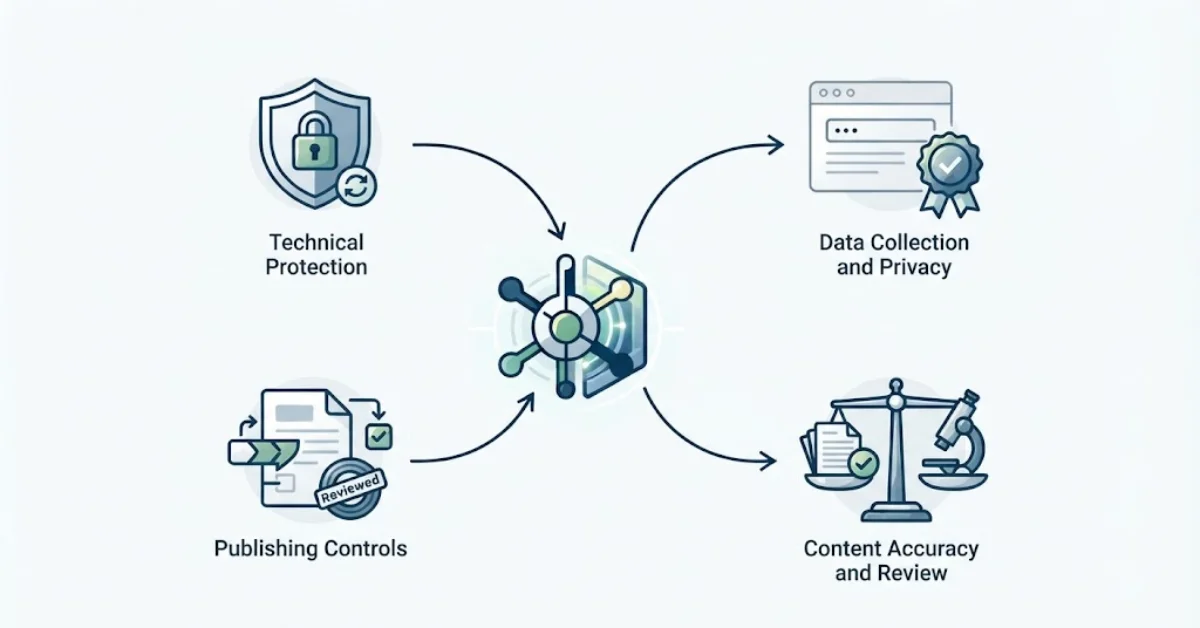
A responsible development process should address several areas:
- Technical protection: use HTTPS, maintain software updates, restrict administrative access, and establish appropriate backup procedures.
- Data collection: explain why information is collected, limit forms to necessary fields, and handle submissions according to applicable privacy requirements.
- Publishing controls: define who can create, review, approve, and update important pages.
- Content accuracy: establish a process for correcting outdated statements, replacing obsolete documents, and reviewing scientific claims.
Pharmaceutical content may introduce additional considerations. A company discussing prescription products or making medical claims needs to assess the regulatory requirements relevant to its activities and communications.
Scientific and regulatory review should be built into the publishing process when required. A general disclaimer cannot substitute for appropriate review, and not every biotech website is subject to identical rules.
These measures protect more than the website itself. They help maintain the accuracy and consistency of information that external audiences use to evaluate the organization.
6. Develop an SEO Structure That Matches Scientific Search Intent
Search optimization works best when each page addresses a specific information need. Biotechnology companies should avoid treating every relevant keyword as a reason to publish another page.
A stronger approach begins by separating the website’s principal audiences and their search intentions.
Someone looking for a biotechnology company’s research platform needs different information from someone comparing laboratory suppliers or seeking employment. For example, searches such as “Legend Biotech careers” and “Bio-Techne careers” generally indicate job-related intent. “Top biotechnology companies” suggests company discovery, while “biotech website design” points toward website design services or research into the subject.
Similarly, a search for pharmaceutical companies in Seattle is geographically focused and does not automatically indicate a need for web development. These terms should be addressed only when the page genuinely serves the relevant audience.
For a company offering website development, a practical SEO foundation includes descriptive page titles, useful headings, readable URLs, relevant internal links, and original content that answers visitors’ questions.
Technical considerations also matter. Search engines should be able to access important pages, and visitors should not encounter unnecessary delays caused by oversized images or excessive scripts.
A content plan can group related subjects into meaningful themes:
- Core service pages explaining website design, development, redesign, and maintenance.
- Educational articles about scientific communication, accessibility, and website planning.
- Relevant project examples demonstrating design decisions and business requirements.
Each page should have a distinct purpose. Avoid repeating the same keyword in every heading or creating multiple pages that compete to answer the same question.
Search performance should be evaluated through actual results, including impressions, qualified organic visits, engagement, and inquiries. No particular ranking or traffic increase can be guaranteed within a set number of days.
7. Choose Technology That Supports Future Growth
A website should be practical to operate after launch. A visually impressive platform can become expensive or difficult to maintain if routine updates require extensive developer involvement.
The right content management system depends on the organization’s requirements, internal capabilities, security expectations, integrations, and budget. There is no single platform that is best for every biotechnology company.
Before selecting a solution, determine how frequently content will change, whether different teams need publishing access, and whether the website requires specialized functionality. Consider integrations with recruitment platforms, customer relationship management systems, investor resources, or other tools only when they support a genuine business need.
Performance should also be part of the technical specification. Compress images appropriately, remove unnecessary scripts, and test important pages under realistic conditions. A fast website is more useful when its forms, navigation, and content also work reliably.
Plan for ongoing maintenance from the beginning. Assign responsibility for software updates, backup checks, broken links, content reviews, and technical monitoring. Establish a process for retiring outdated pages without creating unnecessary navigation problems.
A thoughtful life science website design strategy combines an appropriate platform with a structure that can adapt as research programs, teams, and business priorities change.
How to Select a Website Design Partner for a Biotech Business
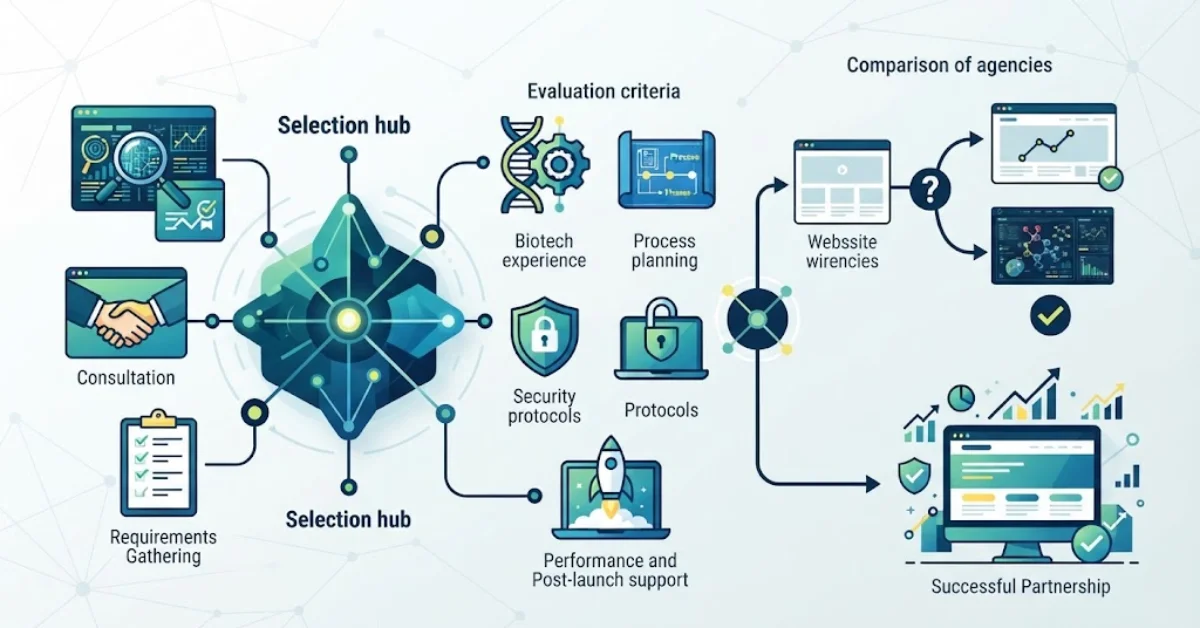
Choosing a development agency is a business decision, not simply a visual preference. The provider should understand the importance of scientific accuracy, audience-specific communication, accessibility, and reliable technical implementation.
Ask prospective partners how they discover project requirements, organize content, approach responsive design, test accessibility, and manage post-launch support. Review their work for clarity and functionality rather than relying on screenshots alone.
A useful evaluation checklist includes:
- Relevant experience with technically complex or science-related businesses.
- A clear process for content planning, design, development, and testing.
- Transparent scope, deliverables, timelines, and pricing.
- Appropriate security practices and support arrangements.
- A realistic plan for future updates and website performance monitoring.
For companies comparing a specialist agency with a general web development provider, the most important consideration is whether the proposed team can meet the project’s actual needs.
Website For Clinics provides website design and development services. Organizations considering a new website or redesign can discuss their requirements, target audiences, content needs, integrations, and maintenance expectations before choosing a suitable project scope.